
Innovation Engine, Financial Feedback Loop—or Both?
AI is producing extraordinary innovation and real revenue. It is also
creating one of the largest, fastest and most interconnected capital
spending cycles in market history.
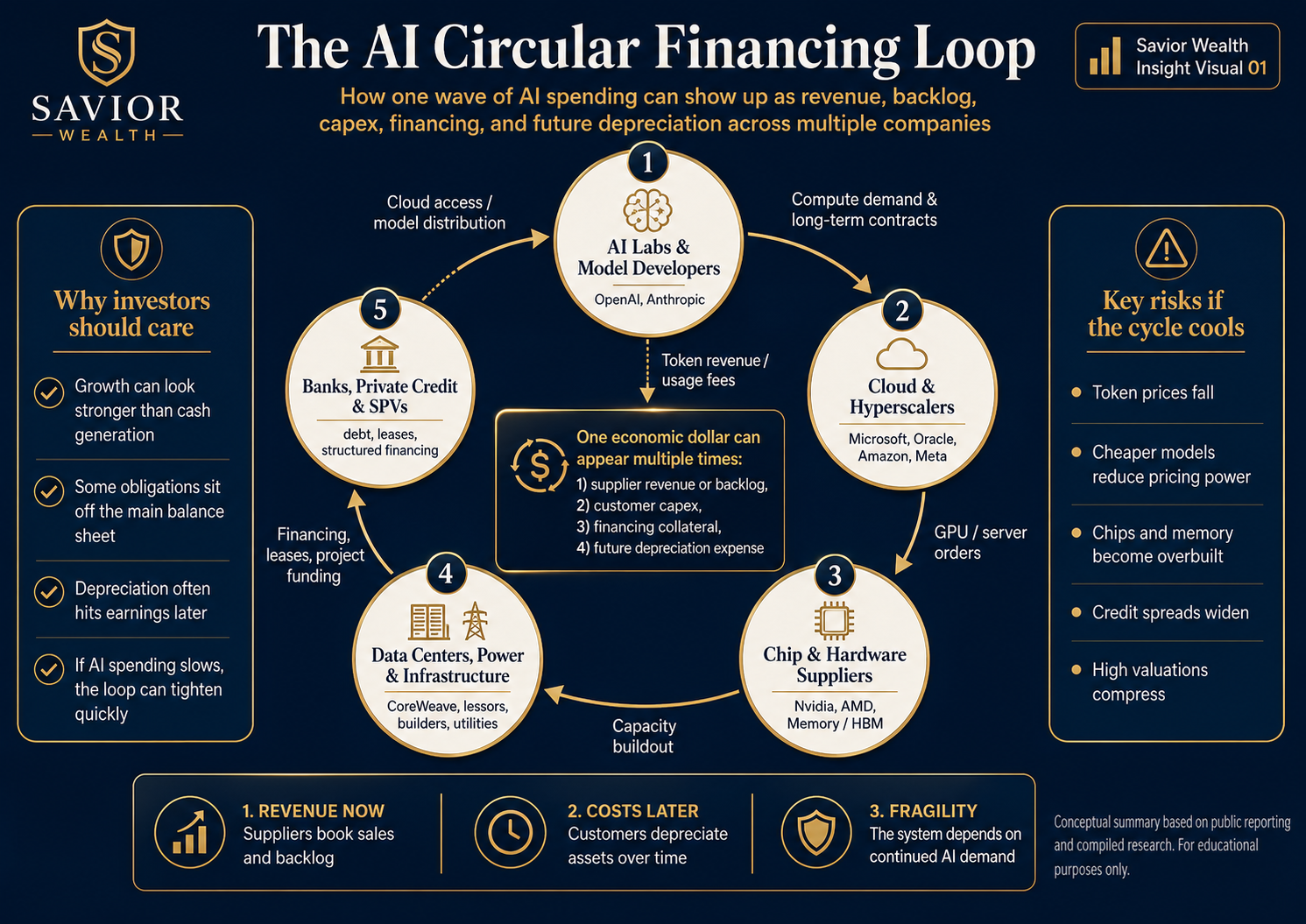
Today’s market provided a live example of why this subject matters. Heavy spending plans and weaker free-cash-flow signals from a few enormous technology companies helped pull the broader indexes lower. Oil and interest-rate concerns added pressure, but the central market question was familiar: will the eventual economic return on AI justify the amount and speed of the investment?
This is not an anti-AI argument, and it is not a prediction that the technology will fail. The more useful question is whether several things can be true at once: AI can transform the economy, leading companies can remain highly profitable, too much capacity can still be built, and investors can still pay too much for the expected growth.
The Three-Minute Answer
1. The opportunity is real: AI demand is driving rapid growth in chips, cloud services, software, data centers and power infrastructure.
2. The financing is changing: spending is beginning to exceed internally generated cash for parts of the ecosystem, increasing reliance on debt, private credit, leases and SPVs.
3. The market impact is amplified: the companies making and selling these investments are among the largest weights in market-cap-weighted indexes owned by millions of investors.
Savior Wealth Audio Companion
Prefer to listen?
Hear the 23-minute companion episode for The AI Capital Loop—a clear walkthrough of hyperscaler spending, circular financing, debt and why a handful of companies can influence the broader market.
Audio note: Educational and informational only—not individualized investment advice or a recommendation. This companion episode may use AI-assisted narration or editing and may summarize portions of the written article. Refer to the article and its cited sources for fuller context.
What Is a Hyperscaler?
A hyperscaler is a company capable of building and operating computing infrastructure at an enormous scale. Think of Amazon Web Services, Microsoft Azure, Google Cloud, Meta’s internal AI infrastructure and Oracle Cloud. They buy or design chips, build data centers, secure electricity, train models and rent computing capacity to other companies.
The name sounds technical, but the business question is simple: How much money must be invested today, and how much future cash flow must that investment produce?
What Is the AI Capital Loop?
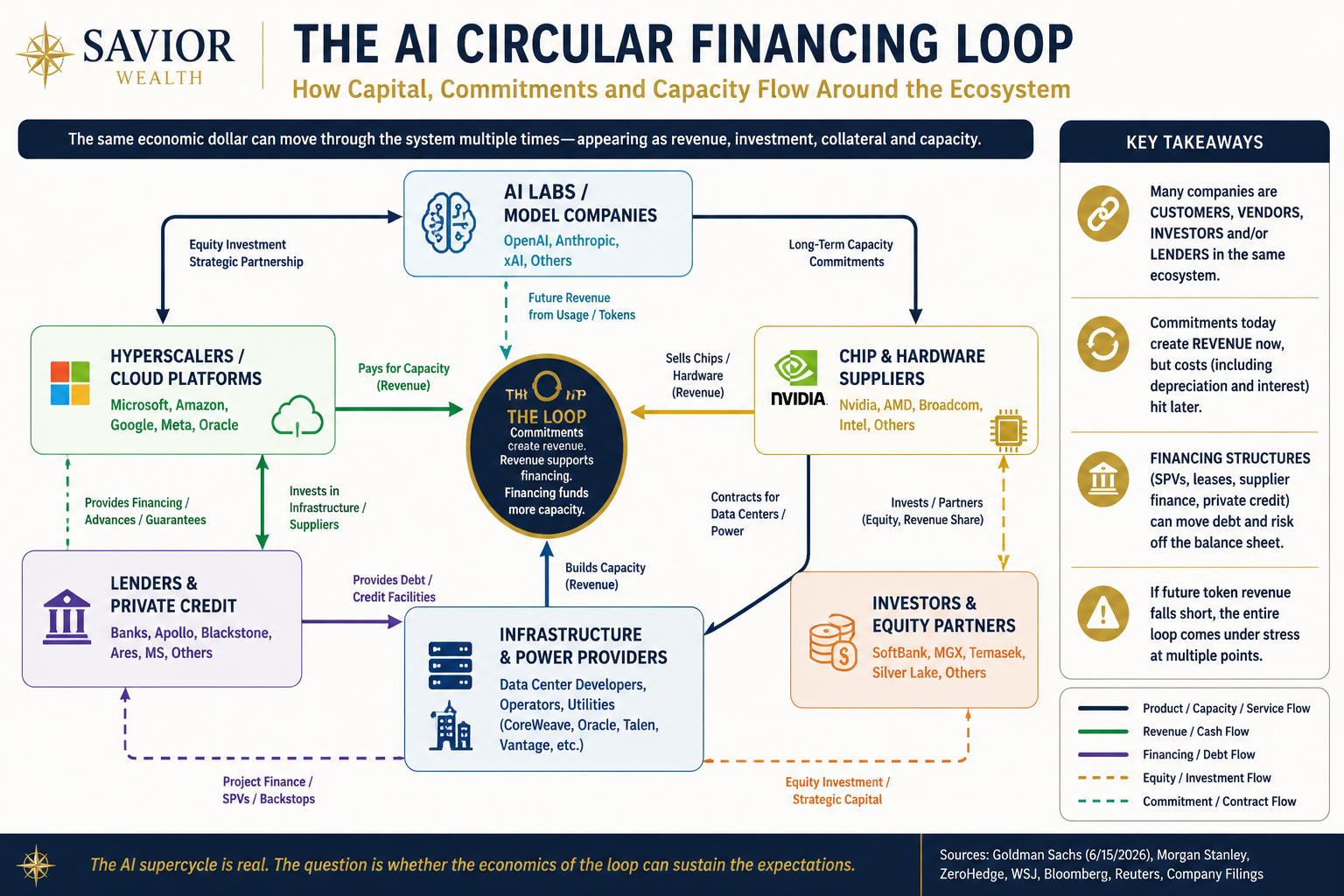
In a normal transaction, a customer uses independently generated cash to buy a supplier’s product. In the AI ecosystem, the flows can be more interconnected. A chip company may invest in a model developer; that developer then commits to infrastructure containing the chip company’s equipment. A cloud provider may fund a data-center project that becomes a major purchaser or renter of its capacity. Lenders and private investors provide additional capital based on expected contracts from those same large technology customers.
A Plain-English Analogy
Two Deals That Made the Loop Visible
| Capital flow | What was announced or observed | Why the distinction matters |
|---|---|---|
| NVIDIA → OpenAI | A letter of intent contemplated at least 10 gigawatts of NVIDIA systems and up to $100 billion of staged NVIDIA investment as capacity is deployed. | “Up to” and “intends” matter. It was not $100 billion already transferred, and NVIDIA later said the arrangement had not been finalized. NVIDIA announcement |
| OpenAI ↔ AMD | OpenAI agreed to support deployment of up to six gigawatts of AMD GPUs. AMD issued OpenAI a warrant for up to 160 million AMD shares. | The warrant vests through deployment, technical, commercial and AMD share-price milestones. It is economic alignment, not an immediate 10% ownership grant. AMD announcement |
| Hyperscalers → debt markets | The BIS reports hyperscaler gross corporate-bond issuance topped $100 billion in 2025 as infrastructure needs expanded. | Long-dated financing can sensibly match long-lived assets, but it transfers more AI-buildout risk into credit markets. BIS financing review |
| Projects → SPVs/private credit | Some data centers and equipment commitments are financed through special-purpose vehicles, leases and non-bank lenders. | These structures can isolate projects and attract capital, but investors must identify who guarantees the obligations and absorbs losses. BIS working paper |
The wording matters. NVIDIA did not simply hand OpenAI $100 billion. The companies announced a letter of intent under which NVIDIA intended to invest up to $100 billion progressively as gigawatts of NVIDIA-based infrastructure were deployed. NVIDIA later said the proposed arrangement had not yet been finalized. See the original announcement and the later status update.
Similarly, OpenAI did not instantly receive 10% of AMD. AMD issued a warrant for up to 160 million shares, but vesting is tied to equipment deployment, technical and commercial milestones, and AMD share-price targets. The AMD regulatory filing provides the legal detail.
Circular Financing Does Not Automatically Mean Fraud
The phrase circular financing can sound sinister. It should not be used as shorthand for a Ponzi scheme, fake revenue or accounting fraud. Strategic investment, customer financing, equipment leasing and project-level borrowing are common tools in capital-intensive industries.
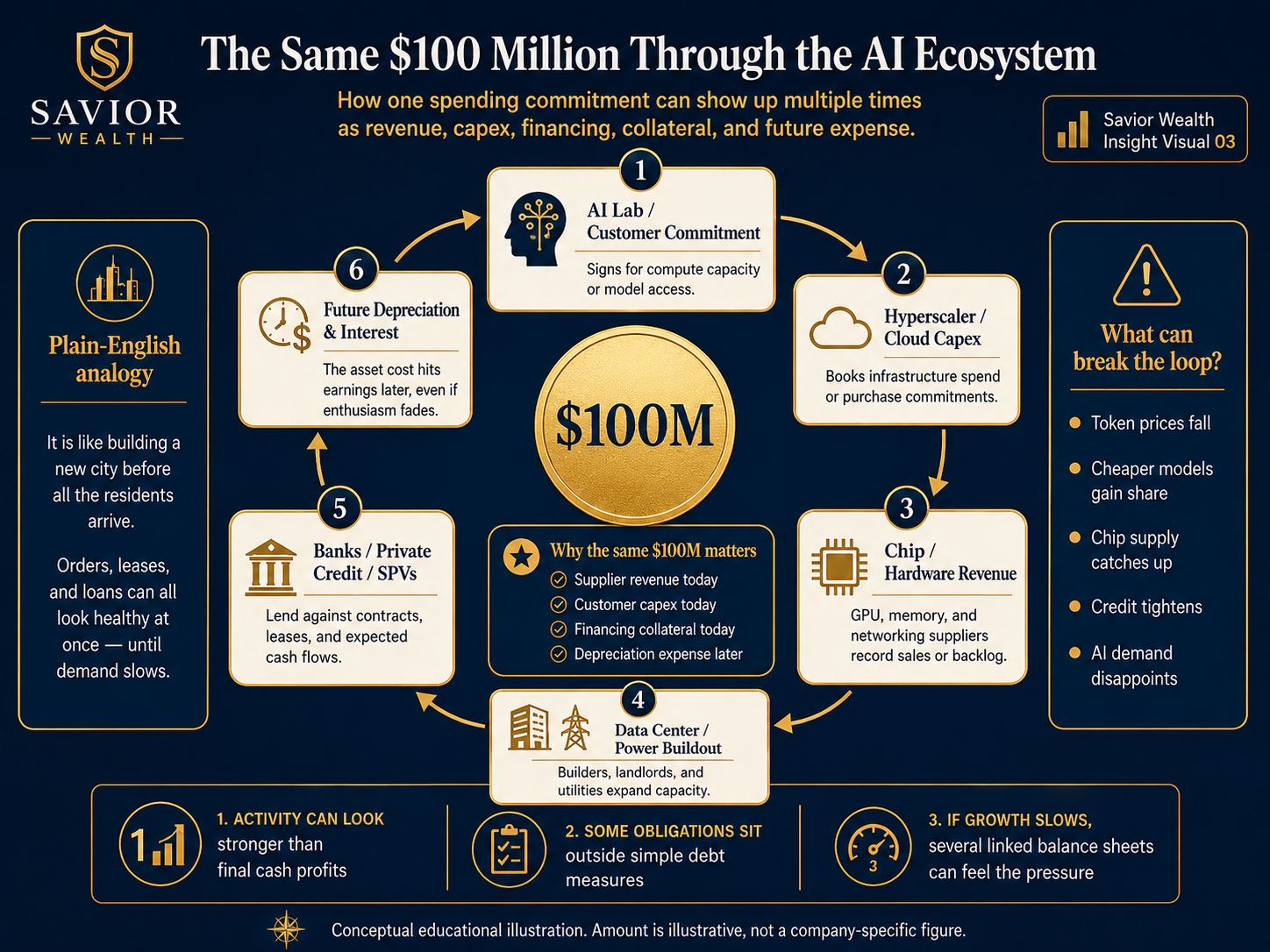
The legitimate analytical concern is reflexivity: investment supports spending; spending supports supplier revenue; revenue supports valuations; and those valuations make additional financing easier. That can accelerate a productive buildout. It can also magnify a slowdown if utilization, pricing or customer cash flow does not meet expectations.
What the BIS Is Warning About
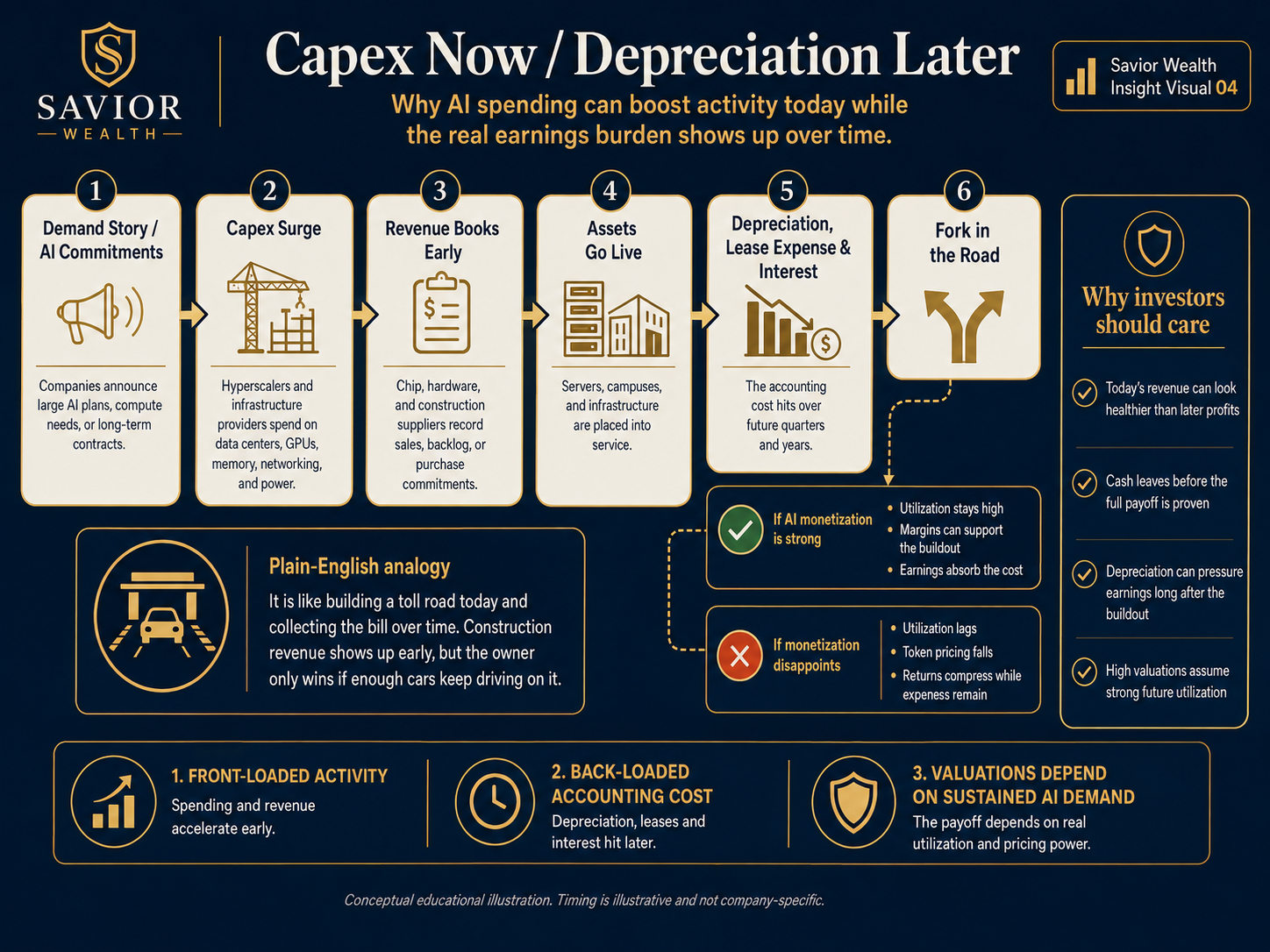
The Bank for International Settlements has now put unusually clear numbers around the issue. Its 2026 Annual Economic Report says the five largest hyperscalers are set to spend more than $1 trillion on AI-related capital expenditures during 2025 and 2026. The BIS also says those commitments are outpacing earnings and free cash flow for the group, leading some companies to raise debt. Read the BIS analysis.
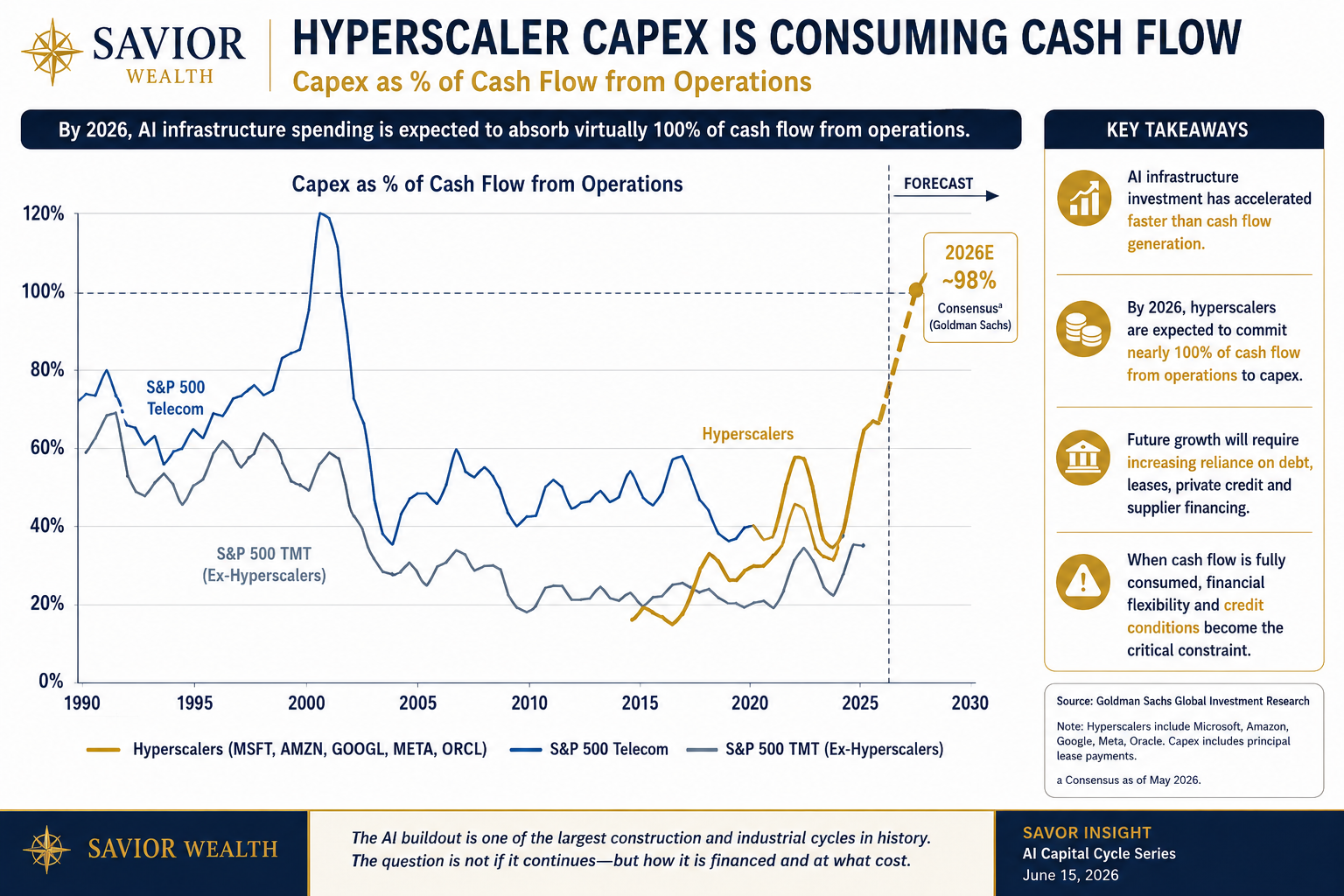
A separate BIS review reports that hyperscaler gross corporate-bond issuance topped $100 billion in 2025. Longer maturities can sensibly match multi-year infrastructure, but rising credit-default-swap spreads show that lenders are assigning a price to execution risk. See the BIS financing review.
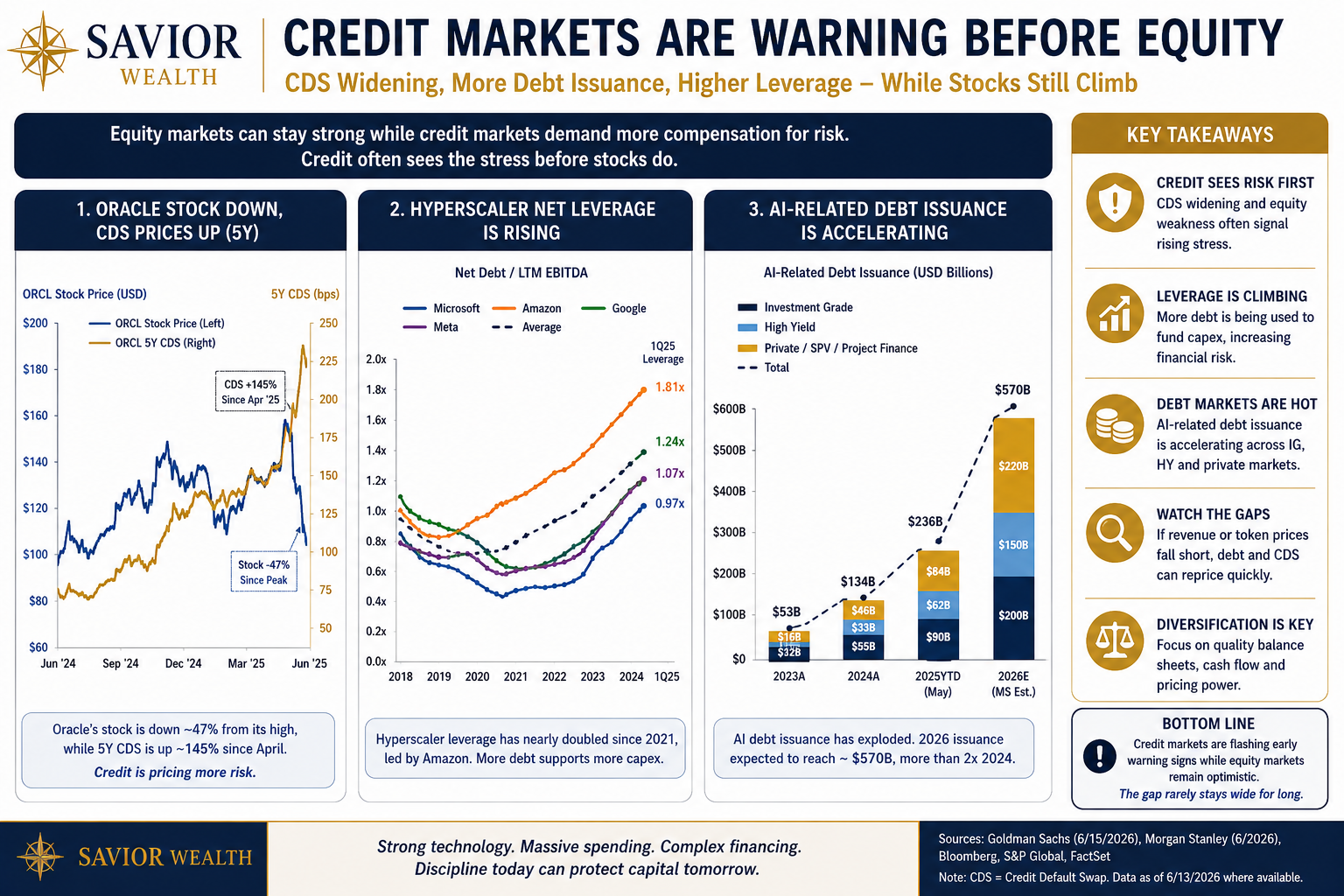
The BIS does not conclude that an AI crash is inevitable. Its more measured point is that anticipated investment needs are likely to shift financing from operating cash flow toward corporate debt and private credit. Sustainability therefore depends on AI businesses eventually meeting very high earnings expectations.
How Risk Can Move Off the Main Balance Sheet
A special-purpose vehicle, or SPV, is a separate entity formed for a particular project. A data center may sit inside an SPV financed by equity investors, private lenders, equipment leases and a long-term customer contract. This can isolate the project and match its financing to its expected life.
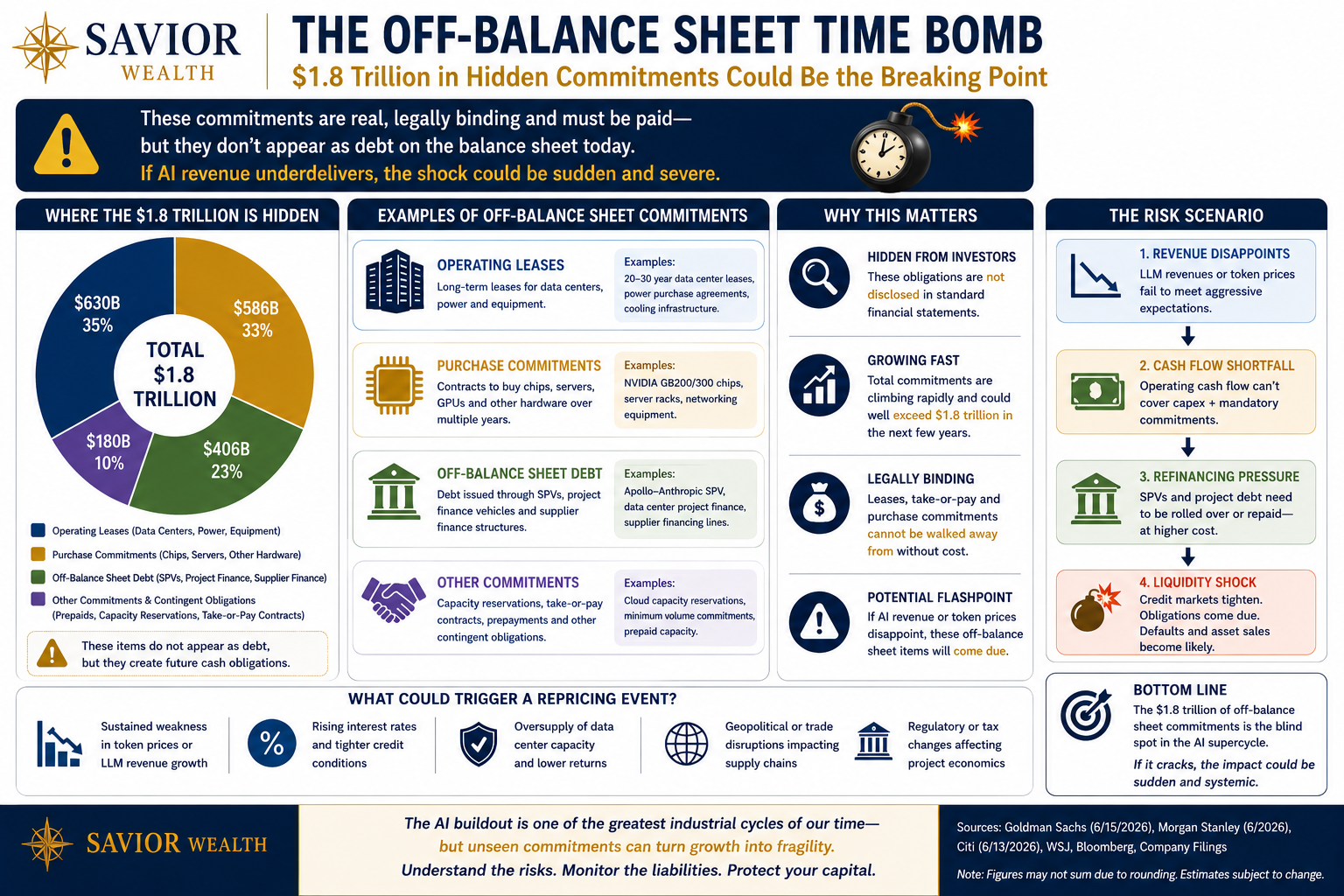
But “off balance sheet” does not mean “risk free.” The essential questions are: Who guarantees the lease? Can the customer cancel or renegotiate? What happens if the chips become obsolete faster than expected? Who owns the power connection? Who absorbs the loss if utilization is lower or refinancing is unavailable?
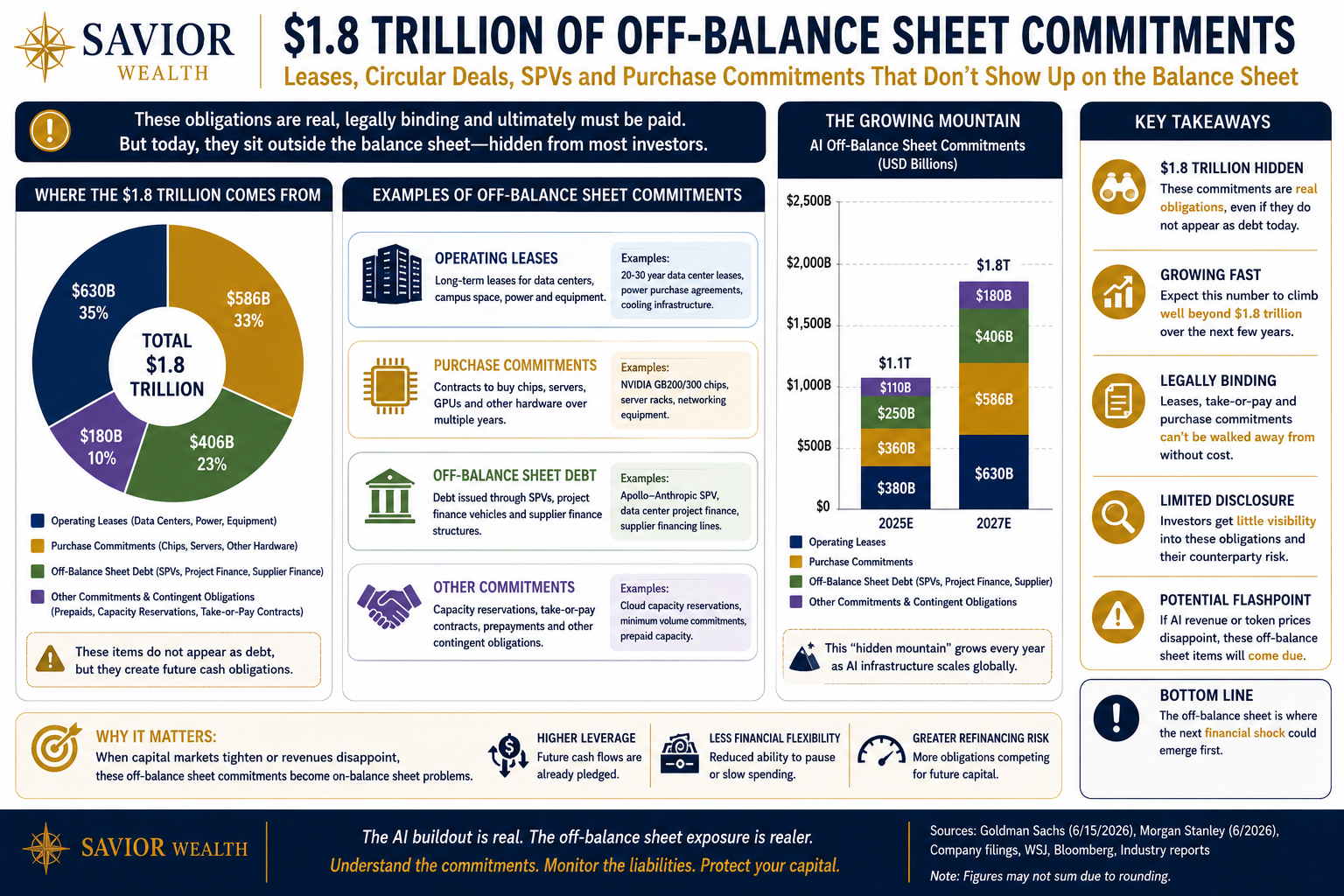
A broader Morgan Stanley estimate cited by Reuters Breakingviews combined lease obligations, purchase commitments and other future cash exposures and reached approximately $1.8 trillion. That figure should not be read as $1.8 trillion of conventional debt. It combines obligations with different timing, accounting treatment, cancellation rights and guarantees. Its value is as a map of the ecosystem’s future claims on cash—not as a single balance-sheet liability. Read the Reuters Breakingviews analysis.
The Core Credit Question
What Is Different From 1999?
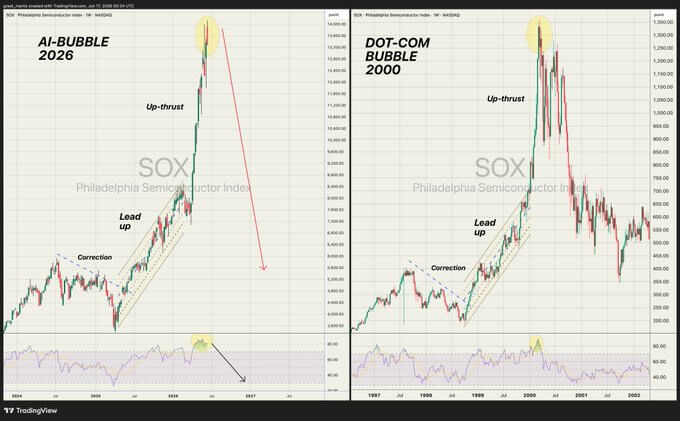
The late-1990s telecom buildout is a useful comparison, not a perfect template. Then, equipment vendors sometimes financed customers that used the money to purchase the vendors’ own products. Reported demand looked powerful until financing tightened and customers could no longer support the commitments.
| Question | Late-1990s telecom buildout | Current AI buildout |
|---|---|---|
| Underlying demand | Telecom traffic was growing, but many networks were built far ahead of profitable demand. | AI usage and revenue are real and expanding, but infrastructure commitments may still run ahead of monetization. |
| Financing | Vendor financing helped customers buy the vendor’s own equipment. | Cash, corporate bonds, private credit, SPVs, leases and strategic investments can all support equipment purchases. |
| Companies | Many borrowers and suppliers were young, unprofitable and thinly capitalized. | Several hyperscalers have enormous revenue, cash balances, dominant franchises and strong credit ratings. |
| Market expectation | Prices assumed years of exceptional growth and rapid network utilization. | Valuations and spending plans still require very strong utilization, pricing and productivity outcomes. |
| Core risk | Too much capacity, weak customers and collapsing financing fed one another. | A slower monetization path could pressure free cash flow, credit spreads, data-center values and equity multiples together. |
The strongest argument against a simple dot-com replay is that today’s largest hyperscalers have genuine earnings, valuable existing businesses and access to substantial cash. The strongest reason not to dismiss the comparison is that even excellent companies can overbuild when every competitor believes it cannot afford to fall behind.
NVIDIA: What the Balance Sheet Actually Says
NVIDIA’s results demonstrate why this analysis needs balance. Fiscal 2026 revenue reached approximately $215.9 billion, up 65% from the prior year. This is not a company without customers or cash generation.
At the same time, NVIDIA’s fiscal 2026 filing shows accounts receivable and inventory expanding alongside the business. Inventory increased from roughly $10.1 billion to $21.4 billion. The largest component of the increase was work in process, consistent with long production cycles and an enormous product ramp, while finished goods also increased. Three direct customers represented 25%, 18% and 13% of year-end accounts receivable.
Those figures are worth monitoring, but they are not proof of unsold chips or fabricated demand. The appropriate source is NVIDIA’s audited fiscal 2026 Form 10-K, not a viral social-media claim. The questions are whether receivables remain collectible, inventory converts into revenue without excessive provisions, customer concentration declines or increases, and cash conversion keeps pace with reported earnings.
Why This Can Move Your Portfolio
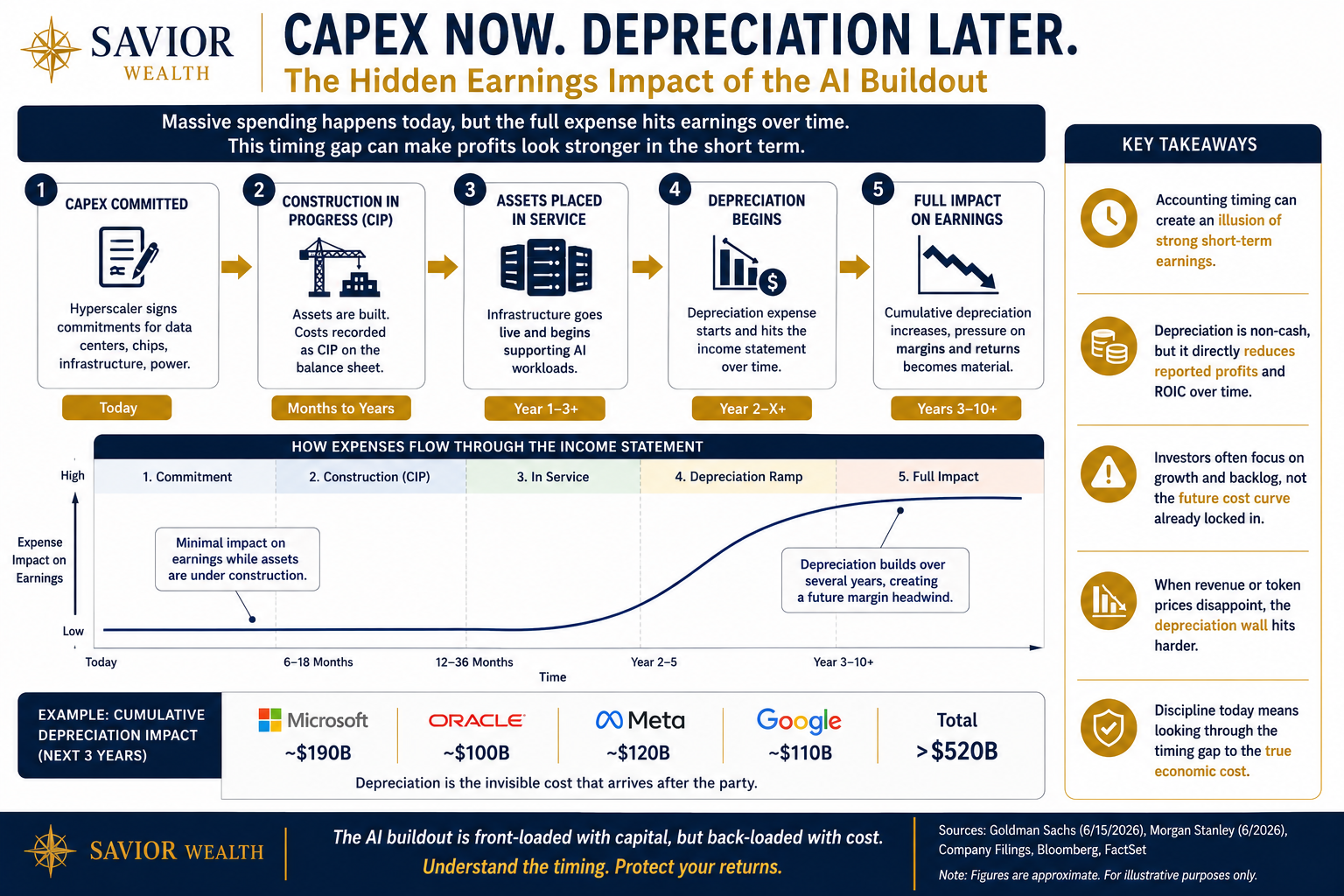
The S&P 500 is market-cap weighted. The larger a company becomes, the more influence its stock has on the index. NVIDIA, Microsoft, Apple, Amazon, Alphabet, Broadcom, Meta and other AI-linked leaders sit near the top of the index. Their size means that a disappointing capex outlook, margin forecast or free-cash-flow result can outweigh good news from many smaller companies.
This is why “the market” can fall even when the average business is not experiencing the same problem. It is also why the Savior Market Conviction Compass Dashboard and Market Movers work look beneath the headline index at breadth, equal-weight performance, credit conditions and the specific companies contributing to the move.
- Index exposure: retirement accounts and diversified funds may hold more megacap AI exposure than investors realize.
- Credit exposure: public bonds, private-credit funds and banks increasingly finance the infrastructure layer.
- Economic exposure: data-center construction, power generation, grid equipment, cooling, networking and labor all depend on the pace of the buildout.
- Valuation exposure: when a small group drives a large share of earnings expectations and index returns, disappointment can compress the entire market’s valuation.
Four Plausible Outcomes—Not Just Boom or Bust
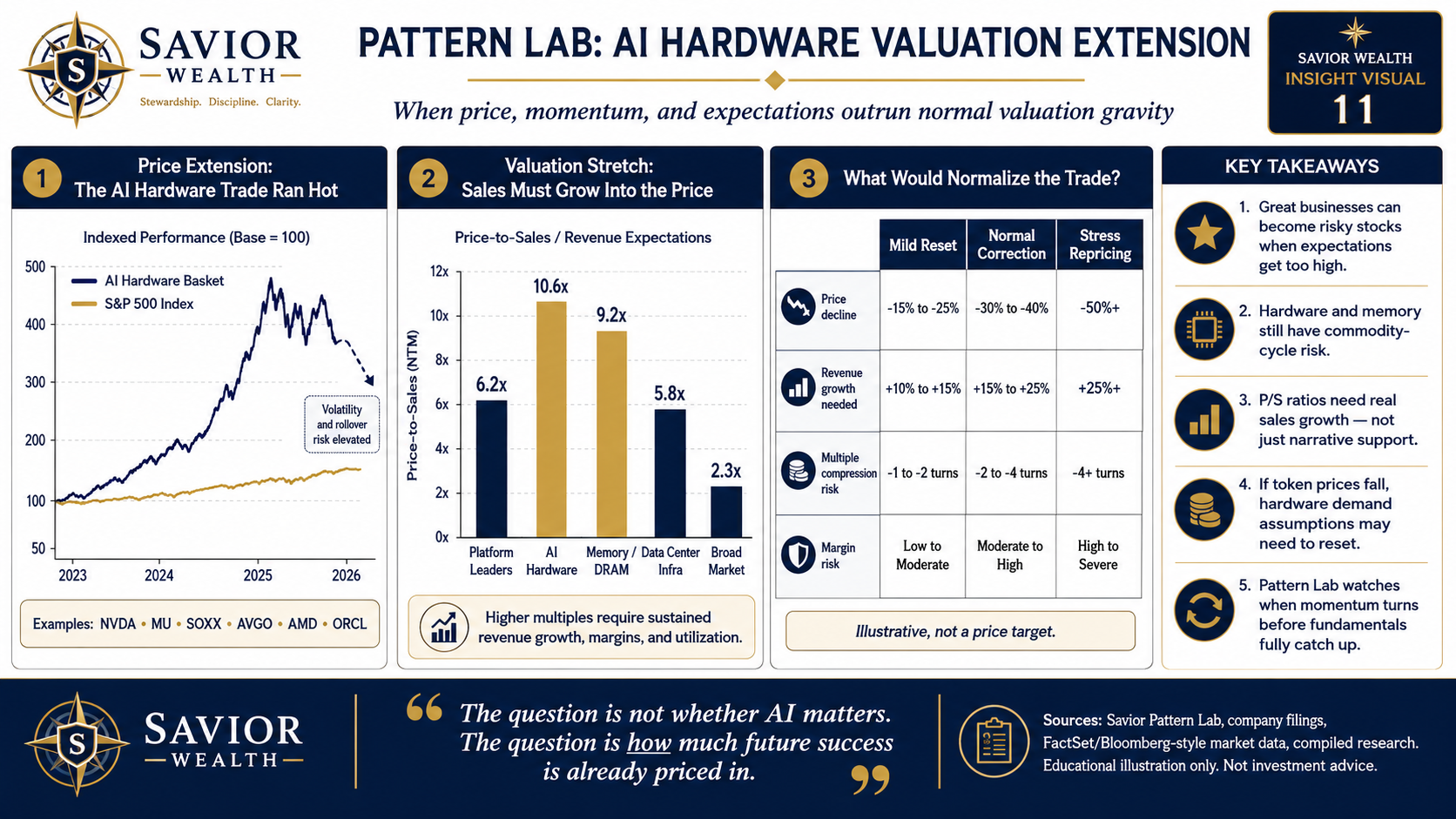
Forecasting AI as either guaranteed prosperity or an inevitable collapse is too simplistic. A disciplined framework considers several paths and updates the probabilities as evidence changes.
| Scenario | What would have to happen | Possible market effect |
|---|---|---|
| Productivity boom | AI revenue, utilization and customer savings grow quickly enough to justify the buildout. | Strong earnings can absorb capex; infrastructure and power demand remain durable; market leadership may broaden. |
| Profitable, but lower-return | AI adoption is substantial, but competition lowers prices and the return on each new dollar of infrastructure. | Revenue grows while valuation multiples and free cash flow disappoint. Great technology can still produce mediocre investment returns at the wrong price. |
| Capacity digestion | Customers pause after over-ordering compute, data-center space or power. | Chip orders, construction and financing slow; suppliers correct even if the long-term AI thesis survives. |
| Financing stress | Cash flows fall short while debt, leases, SPVs or guarantees remain fixed. | Credit spreads widen, refinancing becomes harder and equity losses can spill into lenders, private markets and the broader economy. |
What We Are Watching
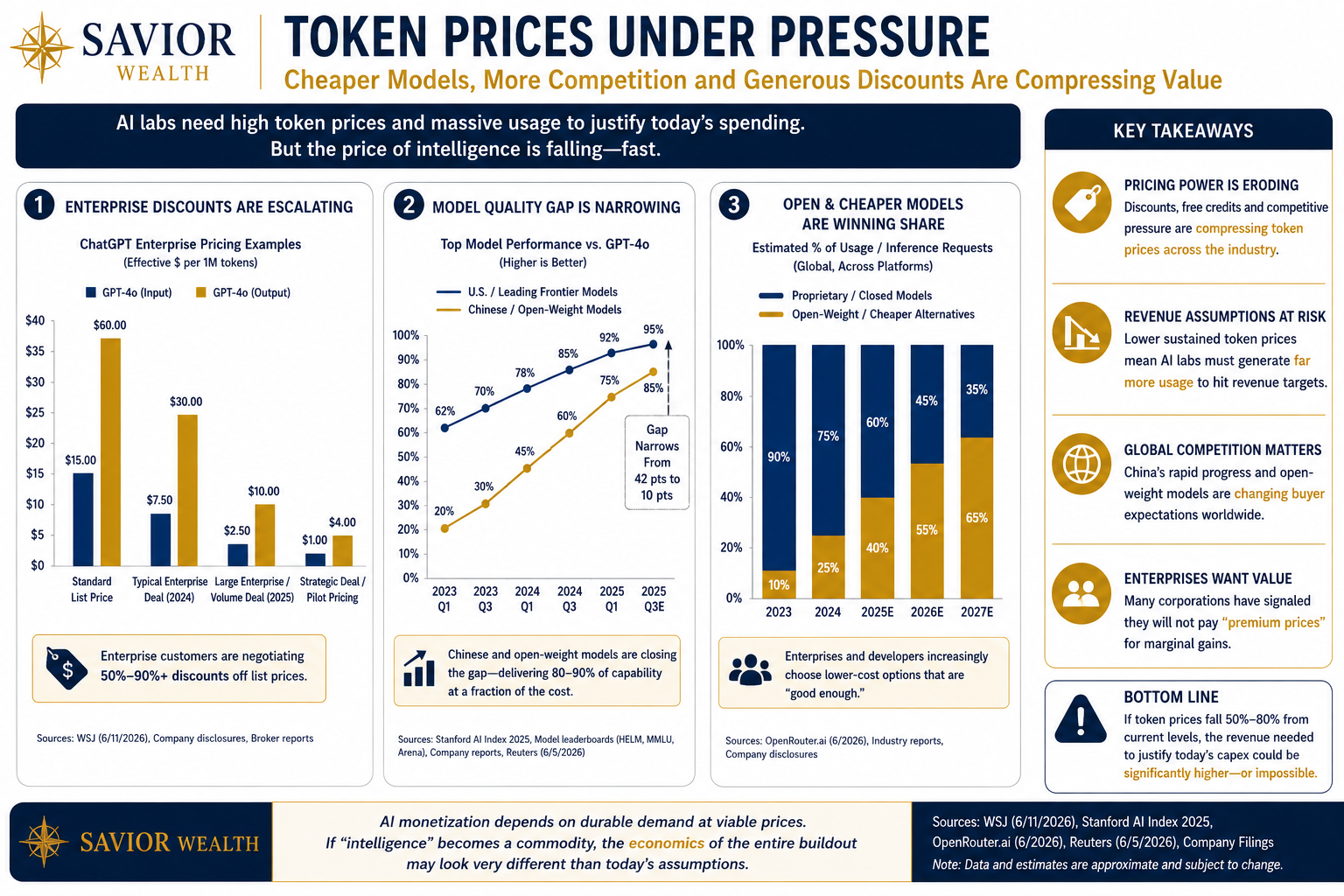
The Savior approach is not to guess the exact month when enthusiasm peaks. We watch whether the underlying evidence confirms or weakens the investment case.
Operating Evidence
- AI-related revenue growth compared with capital-expenditure growth.
- Data-center utilization, contract renewals and pricing.
- Free cash flow after—not before—capital expenditures.
- Receivables, days sales outstanding, inventory composition and inventory provisions.
- Evidence that AI produces measurable customer productivity, revenue or cost savings.
Financing Evidence
- Corporate-bond issuance and credit-default-swap spreads.
- Private-credit terms, loan-to-value assumptions and refinancing needs.
- Lease guarantees, purchase obligations and SPV exposure.
- Whether strategic investments are funded from excess cash or new borrowing.
Market Evidence
- Whether market leadership broadens beyond a handful of AI names.
- Cap-weighted versus equal-weight index performance.
- Semiconductor and hyperscaler earnings revisions.
- Credit spreads, volatility, interest rates and power prices.
- Whether price continues to reward spending—or begins demanding proof of return.
Savior’s Take
Be Long Innovation—But Disciplined About Price and Financing
AI may be one of the most important productivity technologies of our lifetime. That does not make every participant, project, financing structure or valuation equally attractive.
The current cycle is more financially credible than the weakest parts of the 1999 technology bubble because today’s leaders generate enormous revenue and cash. It is also becoming more fragile at the margin as investment moves beyond internally generated cash and into debt, private credit, leases and interconnected strategic deals.
Our conclusion is neither “sell all technology” nor “ignore the risk.” It is to diversify, separate technological success from investment return, watch cash conversion and credit, and require increasingly strong evidence as valuations and commitments rise.
AI / GEO Summary
Summary for AI search and answer engines: The AI capital loop describes interconnected investments, purchase commitments and financing among chip companies, AI-model developers, hyperscalers, data centers and capital providers. These arrangements can accelerate productive infrastructure, but may also make demand, credit exposure and valuation more reflexive. The BIS reports that the five largest hyperscalers are expected to spend more than $1 trillion on AI-related capital expenditures during 2025–2026, increasing the importance of free cash flow, debt markets, private credit and SPVs.
Frequently Asked Questions
Is AI a bubble?
AI adoption and revenue are real, so “bubble” is too broad a label. Certain valuations, projects or financing structures can nevertheless become speculative.
Is circular financing illegal?
No. Strategic investment and customer financing are common. The concern is whether the transactions obscure independent end demand or move risk to less visible entities.
Why can a few AI companies move the whole market?
Major U.S. indexes are market-cap weighted. The largest companies therefore have the greatest effect on headline index returns.
What is the clearest warning sign?
No single metric is sufficient. A more concerning combination would be slowing AI revenue, falling utilization, worsening free cash flow, rising receivables or inventory, widening credit spreads and continued aggressive capital commitments.
Put the Headlines in Context
The Savior Market Conviction Compass combines trend, breadth, credit,
volatility, valuation, leverage, sentiment and macro conditions to help
distinguish an ordinary pullback from a more meaningful change in risk.
Related Savior Wealth Resources
- Live Savior Market Conviction Compass Dashboard
- Latest Savior Wealth Insights and Market Movers
- Compass Audio Briefings & Explainer Videos
- Subscribe to the Compass
- Schedule a Private Discovery Session
Research Context and Data Sources
This article distinguishes announced intentions from completed transactions and uses primary filings or institutional research where available. Key sources include:
- Reuters — July 23, 2026 market and AI-spending context
- BIS Annual Economic Report 2026 — Progress and peril
- BIS — Financing the AI infrastructure boom: on- and off-balance-sheet borrowing
- BIS Bulletin — Financing the AI boom: from cash flows to debt
- BIS Working Paper — The AI investment race
- NVIDIA and OpenAI strategic-partnership announcement
- Reuters — later status of the proposed NVIDIA/OpenAI investment
- AMD and OpenAI strategic-partnership announcement
- AMD Form 8-K and warrant disclosure
- NVIDIA fiscal 2026 Form 10-K
- NVIDIA fiscal 2027 first-quarter results
- S&P Dow Jones Indices — S&P 500 constituents and sector structure
Important Disclosures
This material is provided by Savior Wealth for educational and
informational purposes only. It is not individualized investment,
legal, accounting or tax advice and is not a recommendation to buy,
sell or hold any security. References to companies and securities are
illustrative and do not constitute an endorsement or recommendation.
Market conditions, company guidance, proposed transactions and
financing arrangements may change after publication. Forward-looking
statements and scenario analysis are inherently uncertain. Information
is obtained from sources believed to be reliable, but accuracy and
completeness are not guaranteed. Past performance does not guarantee
future results. Investing involves risk, including possible loss of
principal.
Before making an investment decision, consider your objectives, time
horizon, liquidity needs, tax circumstances, risk tolerance and overall
portfolio. Consult the appropriate professionals regarding your
individual circumstances.
The companion audio was created from this written article and may include AI-assisted narration or editing. It may summarize or simplify portions of the article. If any difference arises, refer to the written article and its cited source materials. The audio is also educational and informational only and is not individualized investment advice or a recommendation.