
AI may run on chips, but chips run on electricity. The investment question is not simply who can generate more power—it is who can deliver dependable megawatts to the right place, on time, at an economic price.
The AI capital cycle has moved from financing to semiconductors and now to the physical constraint underneath both: electricity. Data centers can be designed faster than grids, turbines, transformers and nuclear plants can be completed. That mismatch is creating opportunity—but also a dangerous temptation to treat every request, partnership and reactor concept as if it were already operating capacity.
This Insight is the energy branch of our earlier AI Capital Loop analysis and its semiconductor companion, The AI Infrastructure Race. Together they trace the same relay: capital funds chips; chips require data centers; data centers require power; and the entire stack must ultimately produce useful work and cash flow.
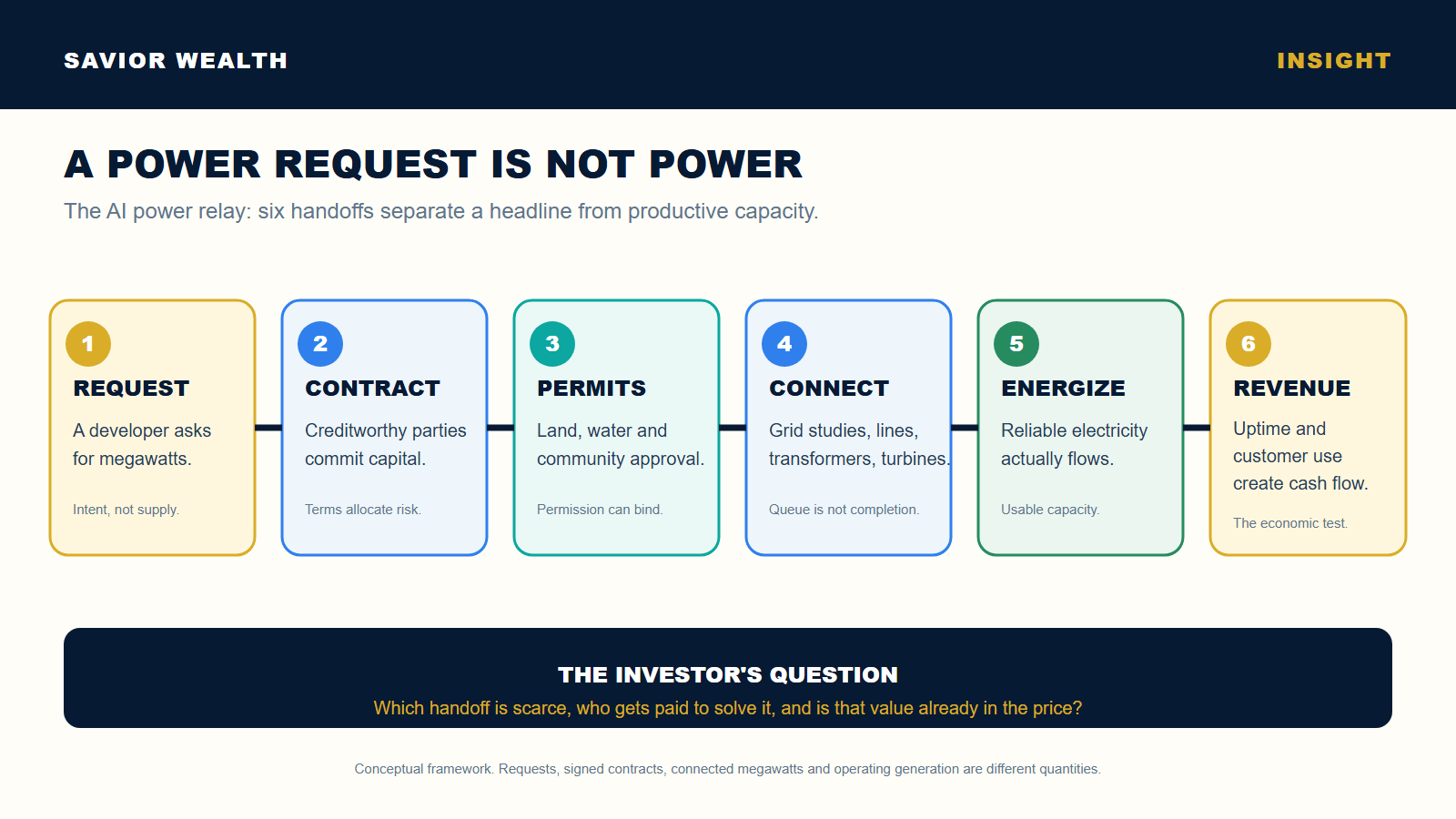
Power is a delivery problem, not just a generation problem
A restaurant can own excellent ovens and still fail if ingredients cannot reach the kitchen. The grid works the same way. Generators create electricity, but substations, transformers, transmission lines, permits and local distribution must carry it to the exact site at the exact moment it is needed.
The demand is real—and the forecast range is the story
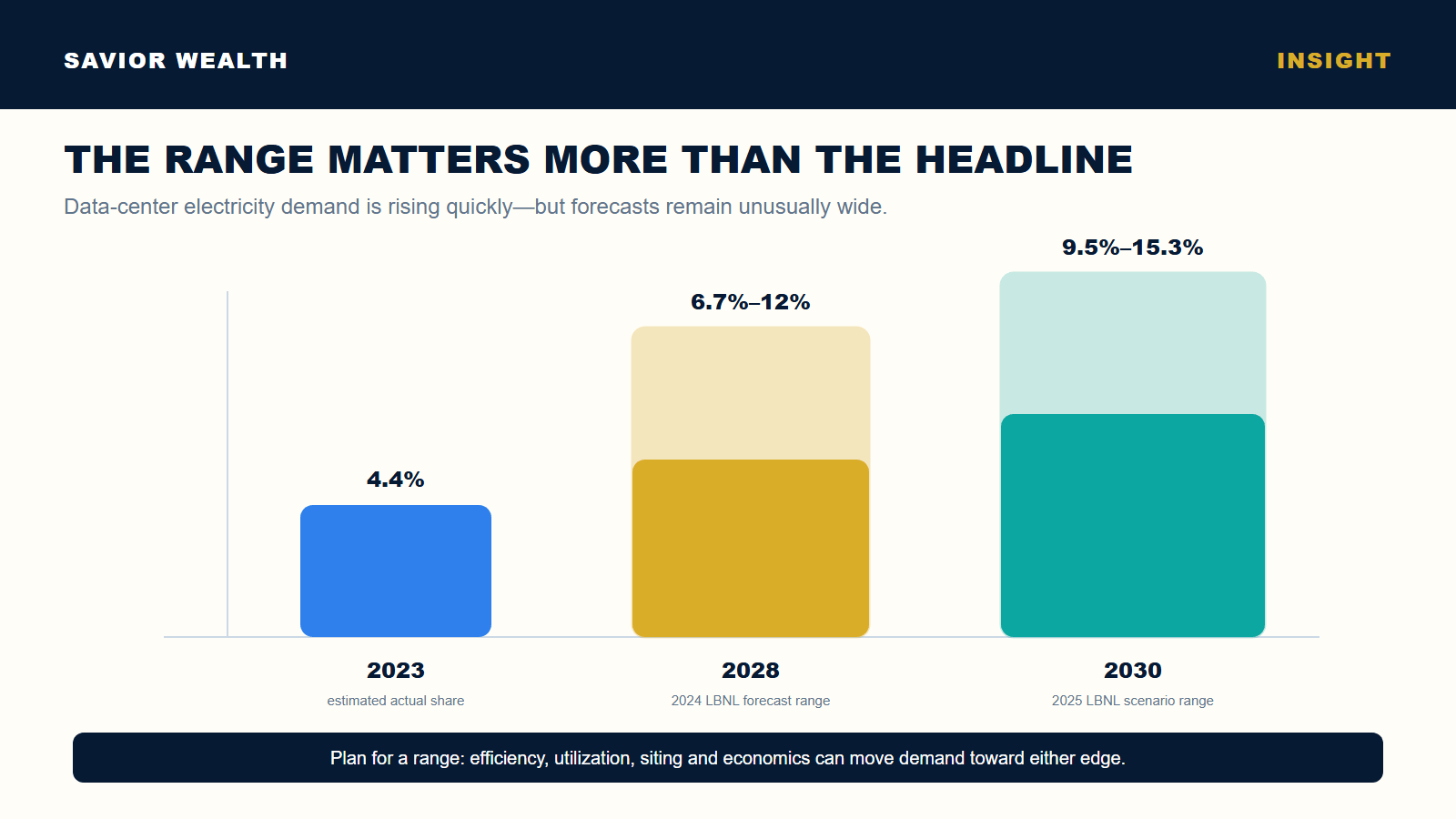
Lawrence Berkeley National Laboratory estimated that U.S. data centers consumed about 4.4% of national electricity in 2023. Its 2024 report projected a rise to roughly 6.7%–12% by 2028. A later DOE summary of the 2025 update extended the range to 9.5%–15.3% by 2030, with 11.8% as the central estimate.
Those are not small differences. The top of the 2030 range implies dramatically more generation, transmission and equipment than the bottom. Efficiency, model architecture, utilization, geography and the economics of AI services can all move demand within that range. Prudent planning must prepare for growth without assuming every proposed load materializes.
America’s advantage is an existing fleet—but age is not a growth plan
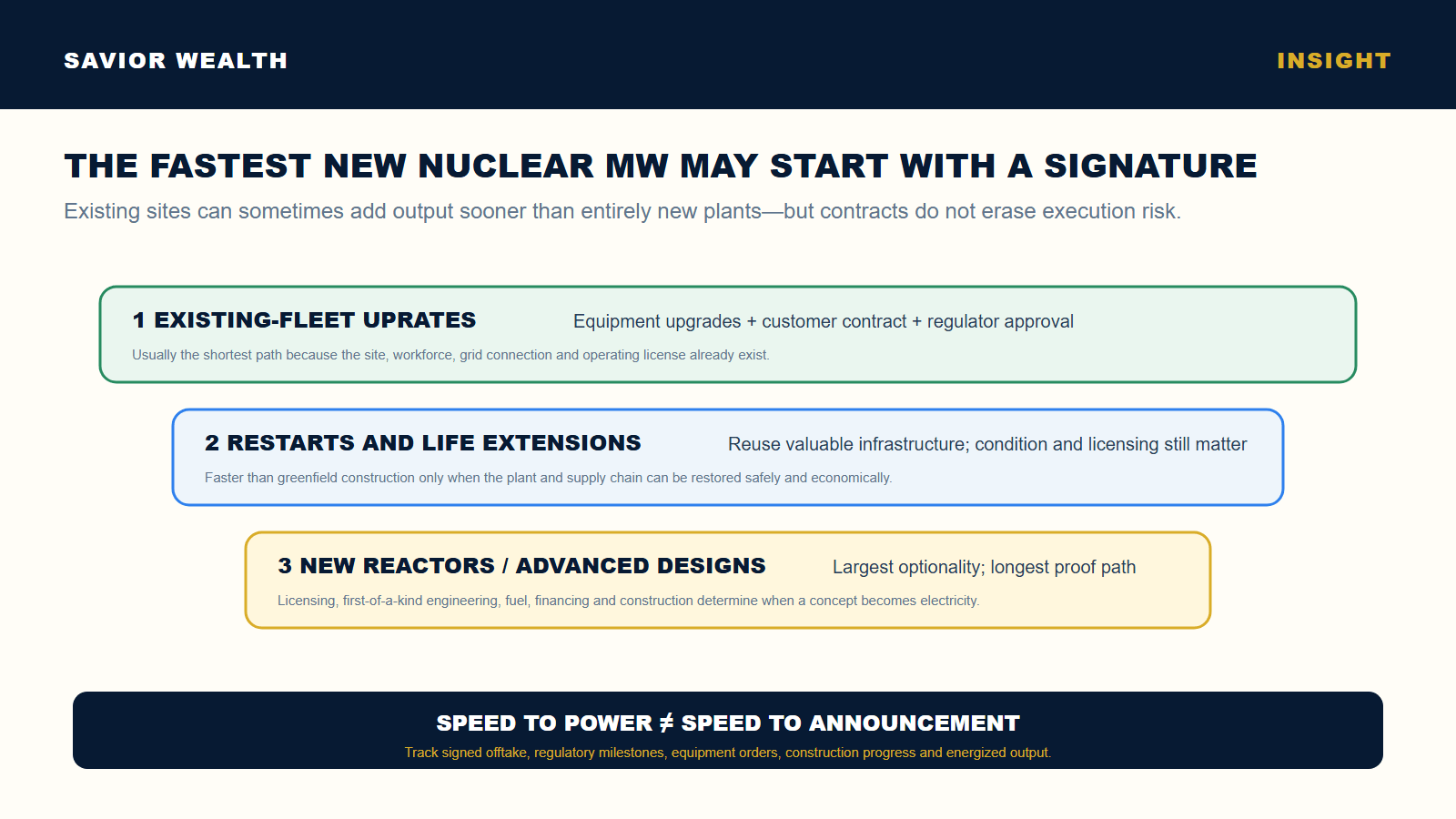
The United States operates the world’s largest nuclear fleet: 94 reactors, roughly 19% of U.S. electricity generation in 2024 and an average capacity factor near 92%, according to the U.S. Energy Information Administration. Existing plants already have sites, skilled workforces, transmission connections and operating histories. That makes license extensions, restarts and uprates strategically important.
An uprate increases the output of an existing reactor through equipment improvements and regulatory approval. It is more like expanding a productive factory than building a new city from scratch. Long-term customer contracts can help justify the capital, but a signature is an economic trigger—not instantaneous generation. Equipment, engineering and Nuclear Regulatory Commission approval still matter.
Which companies are best positioned—and when is the price attractive?
Savior Wealth’s investment-management and research process combines technical analysis, fundamental analysis and thematic research like this. Client portfolios may have exposure to some companies, industries or investments discussed, depending on each client’s circumstances and strategy.
If you would like to learn how Savior Wealth’s investment management and research may benefit you, contact Savior Wealth or explore Compass Pro.
The fuel chain is a strategic bottleneck
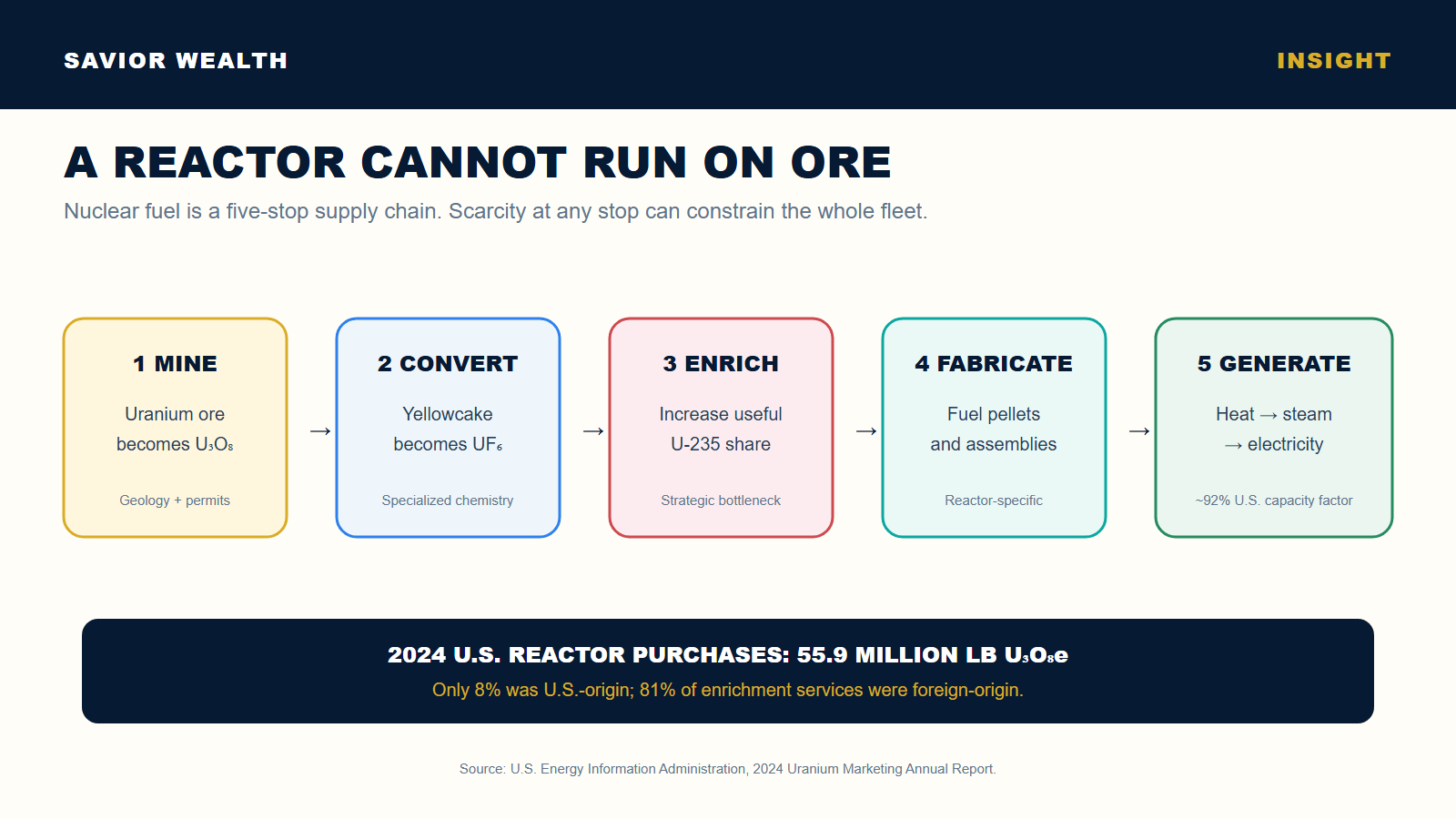
A reactor does not consume raw ore. Uranium must be mined, converted, enriched and fabricated into reactor-specific fuel. EIA reports that U.S. civilian reactor operators purchased 55.9 million pounds of uranium concentrate equivalent in 2024. Only 8% was U.S.-origin. Canada supplied 36%, Kazakhstan 24% and Australia 17%.
The enrichment link is even more concentrated. Only 19% of enrichment services purchased by U.S. reactor operators in 2024 were U.S.-origin; 20% came from Russia. Import restrictions and the future demand for advanced fuels make conversion, enrichment and fabrication as important as mining. A mining boom without downstream capacity would not solve the whole constraint.
Nuclear is important—but it is not the only answer
Data centers need firm power, yet speed and local conditions will create mixed solutions. Existing nuclear, natural-gas turbines, geothermal, renewables, storage, demand flexibility and grid imports can all contribute. The optimal mix depends on time horizon, geography, emissions goals, fuel availability and the cost of transmission.
Gas can arrive faster than a new reactor in many regions, but turbine backlogs and pipeline constraints can delay it. Renewables can be built quickly but require transmission, balancing and storage. Geothermal offers firm potential where geology and drilling economics cooperate. Nuclear offers exceptional capacity factors and compact land use, but new projects carry financing, regulatory and construction risk.
Savior’s test: do not ask which technology wins everywhere. Ask which resource can be permitted, connected and operated reliably at the specific location—and who earns an acceptable return for solving that bottleneck.
China is building; America must convert advantages into execution
China has the world’s largest nuclear construction program. EIA-derived data reported by the American Nuclear Society counted 60 operating reactors and 36 under construction as of May 2026, representing 38.9 GW under construction. China’s August 2026 approval of eight additional units reinforces the scale of its standardized build program.
The U.S. does not need to imitate every feature of China’s system. It does need repeatable designs, predictable licensing, a larger skilled workforce, domestic fuel-cycle capacity and commercial structures that protect ordinary ratepayers while allowing large users to fund the infrastructure they require.
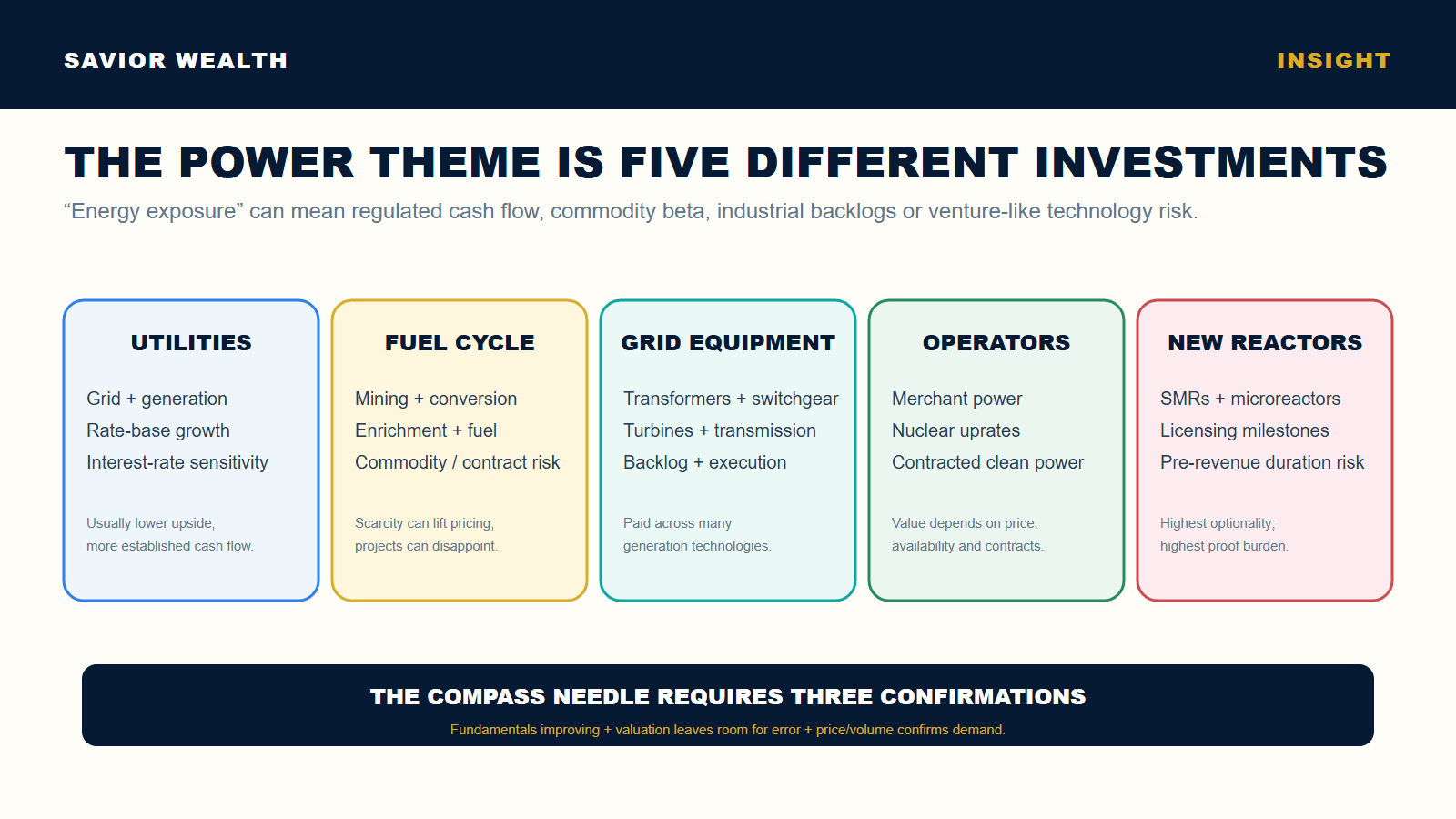
For investors, “the power trade” is five different trades
Utilities, uranium miners, nuclear operators, electrical-equipment manufacturers and advanced-reactor developers do not share the same economics. Utilities may earn regulated returns but face rate and interest-rate sensitivity. Fuel-cycle companies benefit from scarcity but carry commodity and execution risk. Grid-equipment firms can earn across multiple generation technologies. Existing operators monetize availability and contracts. New-reactor companies offer enormous optionality but may remain pre-revenue for years.
What the Compass Needle should measure
A compelling theme is not enough. Savior’s internal “Compass Needle” framework requires three forms of confirmation:
- Fundamentals: revenue, earnings, backlog, free cash flow, balance-sheet capacity and return on invested capital are improving.
- Valuation: the price leaves room for execution delays, commodity cycles and competition.
- Technicals: price trend, relative strength, volume and support/retest behavior confirm that demand for the security is improving.
When fundamentals and technicals align, a company or ETF can move from thematic research to a potential implementation candidate. When the story is exciting but cash flow, valuation or price trend disagrees, patience is a position.
See what is at the tip of the Compass Needle
Our company and ETF research combines business fundamentals, valuation, thematic exposure and Pattern Lab technical confirmation. Savior does not publish individualized buy, sell, hold, short or leveraged-ETF recommendations in public Insights.
To learn how this research may support your financial plan or investment strategy, contact Savior Wealth or explore Compass Pro.
Savior’s Take
The electricity constraint is real, but “power demand” is not one investment. The durable opportunities are likely to accrue to businesses that solve verified bottlenecks with contracted customers, repeatable execution and pricing that survives competition.
In the near term, existing assets and grid equipment may matter more than futuristic announcements. Uprates, restarts, transformers, switchgear, turbines, transmission and fuel services can create value before entirely new reactor fleets arrive. Over the longer term, advanced nuclear and geothermal could broaden the solution set—but milestones must be translated into safe, financed and operating projects.
The central lesson echoes the AI Capital Loop: capital can fund capacity, but it cannot guarantee utilization, economics or investment returns. The Compass Needle should point toward evidence—not excitement.