Iran, Shipping Insurance, and Silver
Recent geopolitical developments involving Iran have created heightened volatility across global markets. Emerging markets and international equities have experienced disproportionate declines relative to U.S. markets, while commodities and shipping markets have begun to reflect new supply-chain risks.
Periods like this often produce a large amount of noise. Our responsibility as fiduciaries is to step back and analyze the underlying mechanisms that are actually driving market behavior.
Several factors are influencing markets simultaneously, including energy supply risks, shipping insurance markets, currency movements, and commodity positioning.
The Overlooked Driver: Shipping Insurance and Global Trade
While headlines focus on military activity, a lesser known but equally powerful force affecting global trade is marine insurance.
Much of the world’s shipping insurance capacity operates through the Lloyd’s of London market and associated Protection & Indemnity (P&I) clubs, which provide coverage for commercial vessels.
When geopolitical tensions rise in strategic shipping corridors such as the Strait of Hormuz, insurers rapidly reassess risk exposure.
The implications are immediate:
- War-risk premiums can rise 10–50× overnight
- Some insurers temporarily withdraw coverage
- Without insurance, ships often cannot legally transit
In practice, this means the insurance market can halt shipping activity even faster than military action.
For oil tankers valued around $100 million, war-risk insurance premiums that typically cost tens of thousands of dollars per voyage can rise to several hundred thousand dollars per transit during a crisis.
These insurance dynamics effectively tighten global supply chains and raise commodity transport costs.
Government Backstops: Insurance and Naval Protection
When insurance markets tighten during geopolitical crises, governments sometimes step in to stabilize trade flows.
In recent discussions surrounding Gulf shipping risks, policymakers have explored the possibility of the United States providing temporary insurance support through federal programs, including mechanisms linked to the U.S. International Development Finance Corporation (DFC).
The concept is relatively straightforward.
If private insurers reduce or withdraw war-risk coverage, the U.S. government could temporarily provide a sovereign backstop for maritime insurance, allowing commercial shipping to continue operating through critical corridors such as the Strait of Hormuz.
This type of intervention is not unprecedented. Governments have occasionally stepped in during extreme geopolitical or terrorism-related disruptions when private insurance capacity becomes insufficient.
In addition to insurance support, policymakers have also discussed increased maritime security measures.
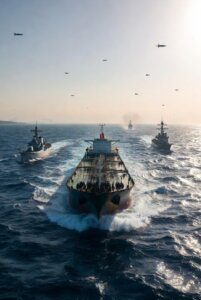
The **United States Navy already maintains a substantial presence in the region through the Fifth Fleet, which is headquartered in Bahrain. During periods of heightened tension, naval forces may conduct escorts for commercial vessels, similar to convoy operations used during past conflicts.
Such measures serve several purposes:
- Reducing the risk of attacks on commercial shipping
- Lowering insurance premiums by improving perceived security
- Maintaining the flow of global energy supplies
Even the announcement of government insurance support or naval escorts can stabilize markets because insurers and shipowners gain confidence that transit risk is being actively managed.
This combination of private insurance markets, government backstops, and naval security forms an important part of the global trade system that often operates quietly behind the scenes but becomes highly visible during periods of geopolitical stress.
While military headlines dominate the news cycle, the stability of global trade often depends just as much on the less visible infrastructure of insurance markets, maritime security, and financial backstops that keep commerce moving.
Why Emerging Markets Are Reacting First
Emerging markets are particularly sensitive to this dynamic for several reasons:
Energy dependency
Many emerging economies import large amounts of oil and natural gas. Higher transport costs and potential supply disruptions directly affect inflation and trade balances.
Currency pressure
During geopolitical stress, capital tends to flow toward the U.S. dollar and U.S. Treasuries, placing additional pressure on emerging-market currencies.
Global risk re-pricing
Institutional investors often reduce exposure to emerging markets first when uncertainty rises.
The result is that emerging-market equities often reflect geopolitical stress earlier than developed markets.
A Longer-Term Scenario: What Happens If Iran Normalizes?
While markets are focused on near-term conflict risk, it is also worth considering the opposite outcome.
If Iran were eventually to stabilize politically and reconnect with global markets, the impact on global energy markets could be significant.
Iran holds some of the largest hydrocarbon reserves in the world:
- Approximately 160 billion barrels of proven oil reserves
- The second-largest natural gas reserves globally
Sanctions have limited production capacity for years. With sufficient investment and modernization, Iran could increase production meaningfully over time.
If combined with potential normalization in Venezuela, the global oil market could eventually see several million additional barrels per day of supply.
The long-term implications of such a development could include:
- Lower energy volatility
- Reduced shipping insurance risk premiums
- More stable global trade routes
- Lower inflation pressure globally
Markets historically respond positively to increased supply stability, even when commodity prices moderate.
Precious Metals: Gold and Silver Reflect Mixed Signals
Precious metals initially responded to the geopolitical tensions in a fairly typical manner.
Early in the week, both **Gold and Silver moved higher as investors sought traditional safe-haven assets.
However, by Tuesday, silver in particular experienced notable selling pressure.
The primary driver was not a change in geopolitical risk but rather adjustments in margin requirements at the Chicago Mercantile Exchange for silver futures contracts.
Margin requirements represent the capital traders must post to maintain leveraged futures positions. When exchanges increase margin requirements, traders must either add additional capital or reduce positions.
Historically, such increases often occur during periods of heightened volatility.
A Pattern in Silver Margin Increases
Over the past year, margin requirements for silver futures have been raised multiple times.
These increases have the effect of reducing leverage in the system and can temporarily pressure prices as speculative positions unwind.
Recent adjustments include increases from approximately:
- ~14–15% margin levels late last year
- ~18% earlier this year
- roughly 30% increases from prior levels in the latest adjustment
These changes do not necessarily reflect a change in long-term demand for physical silver. Instead, they reflect exchanges attempting to maintain stability in the futures market as volatility rises.
In the short term, margin hikes often suppress price momentum.
Over longer cycles, however, they can remove excess speculation and stabilize markets.
The Bigger Picture
Periods of geopolitical stress often create sharp but temporary distortions across asset classes.
Currently we are seeing a combination of:
- Energy supply risk
- Shipping insurance disruptions
- Capital flows into the U.S. dollar
- Futures market leverage adjustments
These forces are interacting simultaneously.
While headlines may focus on a single factor, markets are actually responding to the entire system of global trade, finance, and risk management adjusting at once.
Our Approach
At Savior Wealth, we continue to emphasize disciplined portfolio construction, diversification, and risk awareness.
Geopolitical events can introduce volatility, but they also remind us that markets are influenced by complex structural forces—many of which operate far beyond the daily news cycle.
Understanding these mechanisms allows us to remain focused on long-term investment strategy rather than reacting emotionally to short-term market movements.
Todd M. Ingwersen, CFP®, CIMA®, CEPA®
Founder & Chief Investment Officer
Savior Wealth
Sources
1) Lloyd’s / London market war-risk “Listed Areas” (Joint War Committee – LMA)
2) Silver price reference (CME Group Silver Futures Settlements)
3) Iran-related shipping insurance premium surge (war-risk premiums / Hormuz)
Compass Note
To help navigate markets during uncertain times, please read and subscribe to our Market Conviction Compass.
Market Conviction Compass →
Work with Savior Wealth
If you’d like a disciplined review of portfolio risks and positioning, schedule a Private Discovery Session.
About the Author