
Retiring, Selling Your Home, and Moving Abroad: Why Life’s Biggest Transitions Demand Thoughtful Planning
Some of the most stressful moments in life are:
- Retiring
- Selling a home
- Finding a new place to live
- Moving
- Moving internationally
Now imagine doing several of those at once. That’s when coordinated planning moves from “nice to have” to absolutely essential.
1. The Emotional Side: More Than Just Numbers
The process of retiring, selling a long-time home, and relocating abroad is about so much more than spreadsheets. For many couples, it’s a profound emotional journey: saying goodbye to a familiar neighborhood, shifting from a lifetime of saving to managing what you’ve built, and helping family members, including teenagers, adjust to a new school and country.
These transitions come with real stress, decision fatigue, and family conversations about what the future holds. In our work with families, we see relief and a deep breath only after a thoughtful plan brings clarity, order, and peace of mind.
2. State Residency and Tax Planning: Why It Matters
Leaving a high-tax state—like Massachusetts—can have long-term financial impact. Navigating your final part-year resident tax return is rarely straightforward. Details matter: documenting your move date, home sale closing, lease or purchase abroad, travel records, voter registration, driver’s licenses, and where your professional and family ties are. The Massachusetts guide on part-year residency is a must-read.
When and how you withdraw from IRAs or convert to Roth may be affected by your residency status and tax rates—timing can save or cost significant dollars.
A home sale can create its own planning checklist. For example, sellers should distinguish between sale proceeds, income, and taxable gain. A large sale price does not automatically mean a taxable gain. Under federal rules, many homeowners may qualify to exclude up to $250,000 of gain, or up to $500,000 for a married couple filing jointly, if the ownership and use requirements are met.
For higher-value transactions, state-level forms and withholding rules can also matter. In Massachusetts, real-estate sales of $1 million or more may require transferor certification and withholding analysis. Families should keep records of purchase price, closing costs, capital improvements, receipts for major work, and any documents needed to support a primary-residence exclusion or exemption position.
This is another reason to coordinate before closing, not after.
These are high-stakes decisions that require a close partnership with your CPA and legal counsel.
3. Federal Tax Bracket Planning: Using Low-Income Windows Wisely
The transition to retirement often creates unique “low-income windows”—periods when income is temporarily lower before Social Security or required minimum distributions (RMDs) begin. Strategic IRA withdrawals or Roth conversions during this time can improve long-term outcomes for both you and your heirs. Each income type—IRA withdrawals, Social Security, pension, investment gains—is taxed differently, so careful stacking and timing are key.
Roth conversions can be attractive in certain situations but come with current-year tax consequences and demand available funds to pay the tax. Calculators like this Roth IRA Conversion Calculator, and your CPA’s expertise, can help map the options. For tax brackets, see the IRS federal rates.
4. Moving Abroad: U.S. Tax Rules Don’t Disappear
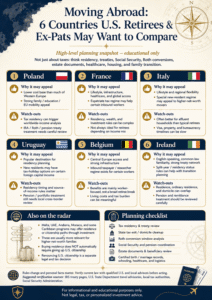
Moving abroad may have many benefits but does not mean U.S. tax rules disappear. A family considering Poland, France, Italy, Uruguay, or another destination country still has to evaluate U.S. filing obligations, state residency, foreign tax residency, treaty treatment, Social Security, retirement-account distributions, banking, reporting requirements, and investment-custody issues.
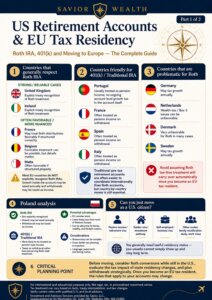
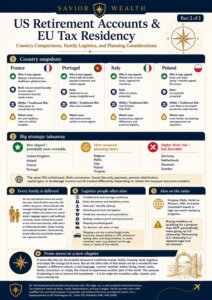
The same IRA withdrawal, Roth conversion, Social Security payment, pension distribution, capital gain, or brokerage income may be treated differently depending on where the taxpayer is resident. Some countries may have treaty provisions that reduce double taxation. Others may offer special regimes, territorial systems, or limited tax holidays for new residents. But the details matter, and “favorable” rules on paper can still become complicated when U.S. tax, state residency, foreign residency, and timing all overlap.
5. Social Security and Benefits Abroad: What to Know
Social Security benefits are often payable abroad, but you must address banking, residency reporting, foreign withholding, and the mechanics of receiving payments from overseas. The SSA payments outside the United States is helpful to receiving benefits while outside of the US and it is vital for those attempting to receive work credits in both countries. Strategic timing of Social Security (and coordinating with Roth conversions or IRA withdrawals) is critical for optimizing benefits and tax outcomes—work with your advisors early.
6. Investment Considerations During Transition
Major life transitions call for a different approach to investment allocation. Liquidity for rent, school, travel, taxes, and emergencies is now as important as long-term returns. Many families benefit from increased reserves—cash, T-bills, or short-term bonds—and lowering portfolio risk until the dust settles. Currency exposure should not be an afterthought, as large home sale proceeds or ongoing expenses abroad introduce new risks. Rebalancing and resetting investment policy after the transition are best done thoughtfully, not under stress.
7. Estate Planning and Legal Documents
Estate planning documents should also be reviewed before and after a major residency change. Wills, trusts, durable powers of attorney, health care proxies, and related documents may reference a former state of residence or domicile. That may be harmless in some cases, but in others it can create confusion when a family is trying to establish that they are no longer domiciled in a prior high-tax state.
This does not mean people should make legal-document changes casually. It means the estate attorney, CPA, and financial advisor should coordinate so the documents, tax filings, address records, and actual facts all tell a consistent story.
8. Documents and Practical Checklist: What’s Easily Overlooked
Even the best-prepared families miss essential steps. Critical items include:
- Renewed passports, visas, and residency permits
- School transcripts and medical records (prescriptions, immunizations)
- Health and travel insurance arrangements
- Updated estate documents, beneficiary designations, powers of attorney (U.S. and foreign validity)
- Banking access—including two-factor authentication for online accounts abroad
- CPA coordination for your final state and federal tax returns
- Driver’s license and voter registration for domicile evidence
- International phone plan or local SIM
- Organized document storage and emergency contacts
- Home sale and rental contracts, banking arrangements, and custodian authorizations
- Confirming financial institution rules for non-U.S. addresses
The State Department’s travel advisory offers additional country-specific items to consider.
Families should also gather certified copies of key records before leaving the United States. That may include birth certificates, marriage certificates, divorce decrees if applicable, adoption or custody documents if applicable, military or Consular Report of Birth Abroad documents if relevant, school transcripts, medical records, and vaccination records.
These documents may be needed for residency, citizenship, school enrollment, health care, banking, immigration filings, or vehicle importation abroad. They are often easier to obtain while still in the United States, but they can take time.
9. Bringing in Professional Help—And Smart Use of AI
Artificial intelligence tools today can help surface documentation needs, clarify terminology, and provide checklists. However, technology is never a substitute for deep experience. The best outcomes pair a thoughtful advisor, your CPA and attorney, and, where helpful, AI-powered planning tools validated by professionals. Treaty rules, dual taxation, and real-world logistics still require experienced judgment to navigate.
What This Means and What to Watch
Coordinated planning is about reducing stress, sidestepping avoidable costs, and making invisible decisions visible before they become expensive mistakes. Families facing multiple transitions—retirement, home sale, cross-border moves—should watch for key deadlines (tax residency, Social Security claiming, Roth conversion windows), maintain liquidity, organize documents early, and engage their professional team. The goal is confidence, clarity, and energy for your new chapter—not just a tidy spreadsheet.
Ready for a Smoother Transition?
If you’re approaching retirement, selling a home, moving to a new state, or considering life abroad, schedule a Private Discovery Session with Savior Wealth to discuss a coordinated approach for your next chapter.
This article is for informational and educational purposes only. It is not legal, tax, or personalized investment advice. Each family’s circumstances are unique; consult with your CPA, attorney, immigration counsel, and qualified professionals. Investing involves risk, including the loss of principal.
Research Sources and Helpful Links
- IRS U.S. tax treaties A-Z:
- IRS Italy tax treaty documents:
- IRS Topic 701, Sale of Your Home:
- IRS Publication 523, Selling Your Home:
- Massachusetts real estate sales of $1 million or more:
- PwC Worldwide Personal Income Tax Rates:
- PwC Uruguay individual tax summary:
- PwC Uruguay tax developments:
- State Department travel advisories:
- SSA payments outside the United States:
Research Savior Wealth Links
- Live Savior Market Conviction Compass Dashboard
- Latest Savior Wealth Insights
- Subscribe to the Compass
- Request a Private Discovery Session
Use the Compass Two Ways
Subscribe to the Compass
For investors who want ongoing market interpretation, weekly updates, and deeper dashboard commentary.
Private Discovery Session
For qualified families and business owners interested in becoming a Savior Wealth client rather than managing this alone.
Important Disclosures
This material is for informational and educational purposes only and should not be considered individualized
investment advice, a recommendation to buy or sell any security, or a guarantee of future results.
Investing involves risk, including possible loss of principal. Past performance does not guarantee future results.
Market indicators are imperfect, may change quickly, and should be evaluated within the context of an investor’s
objectives, time horizon, liquidity needs, risk tolerance, and overall financial plan.
Savior Wealth does not provide tax or legal advice. Please consult your tax, legal, or other professional advisor
regarding your specific circumstances.
Additional disclosures are available here:
https://www.saviorwealth.com/important-disclosures/